
Specific objectives with reference to the creation of the Disaster Risk Programme are emphasized as follows:
- To establish a disaster Risk Management Training and Education Centre in Nigeria.
- To develop an education and training programme for all disaster risk management practitioners.
- To establish a multi-disciplinary research team to conduct disaster risk management research in Africa and beyond.
- To emphasise the vital linkages between disasters, disaster risk management, the developmental process and its consequences on lives, properties and environment.
The overarching mission of the CDRMDS is to produce graduates that will translate their knowledge of Disaster Risk Management into effective tools for sustainable development of the society.
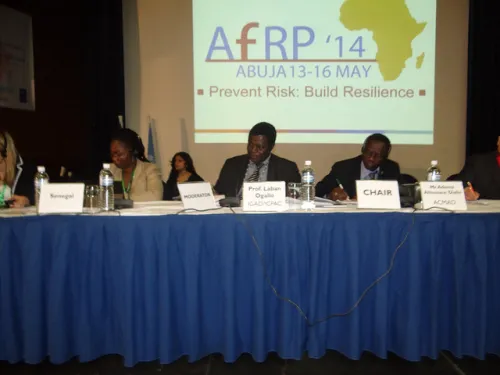
Since its initiation the CDRMDS has been very active, organizing an International Conference on Disaster Management in Abuja in 2012 and assisting the hosting of the Fifth Africa Regional Platform for Disaster Risk Reduction and Third Ministerial Meeting in Abuja. Other activities have included sending delegates to attend and present at several regional and international conferences and workshops. The CDRMDS is also taking the lead in developing a more professional and robust disaster management service within the country through establishing a ‘National Association of Disaster Managers’.
The CDRMDS participated actively in several research projects focused on analyzing the impacts of particular disaster events, their causes, the response by disaster management. This included an assessment of the impact and response towards the major floods which struck Nigeria in 2012. Currently the Centre has begun the Scoping for vulnerability and capacity Assessment for Sabon Gari municipality in Kaduna State. The CDRMDS has also conducted a number of research initiatives as part of students’ projects for their Masters and Post Graduate Diploma degrees. This research has tended to be highly varied, investigate and tackle numerous disaster risk related themes and issues within Nigeria which have included community participation in disaster management, impacts of technological hazards, health risk reduction, urban planning and risk identification and institutional support for disaster risk initiatives.
Academic Courses
The CDRMDS is currently running two Postgraduate academic programs since mid 2010 which include:
- Postgraduate Diploma in Disaster Risk Management and Development Studies (PGDRMDS)
- Master in Disaster Risk Management and Development Studies (MDRMDS)
- Masters of Science in Disaster Risk Management and Development Studies (MSc.)
- Master of Philosophy in Disaster Risk Management and Development Studies (M.Phil.)
- Doctor of Philosophy in Disaster Risk Management and Development Studies (Ph.D.)
The CDRMDS has also commenced a phased program of training its staff in order to meet the challenges of disaster management in Nigeria. Three of its Core staff attended Two training workshops in Stellenbosch University, South Africa and a short course in disaster management in Bangkok, Thailand in 2014.
Short courses
The centre has begun to develop and implement several workshops centred around improving disaster management training within the country. These have included organizing;
- A workshop on Fire disasters in ABU.
- A workshop on Emergency Preparedness and Response in Zaria.
- Currently the Centre plans on developing a West African sub-regional Workshop on Disaster Management centred for addressing disaster management issues and informing practioners based in the Western African region.
On invitation, the Centre also participates actively in NEMA Workshops. These courses are suitable to people interested or currently working in the fields of disaster, risk and emergency management in either the public or private sector, including, Disaster Managers, Security and rescue personnel, Risk Managers, NGO”s, Agricultural Officials, Traffic Personnel, Health Officials, Town Planners, Trauma Officials, Communication Officials, Environmentalists, IT Managers, Information Managers, Police Officers, Military Officials, Sociologists, Psychologists, Anthropologists, Paramedics, Veterinary Officers, Engineers, Road Safety Officers, Quarantine Officers, Civil Defense Corps, Fire Service Officers, NEMA Staff, Aviation Personnel, Red Cross etc.